Quantum dot display materials
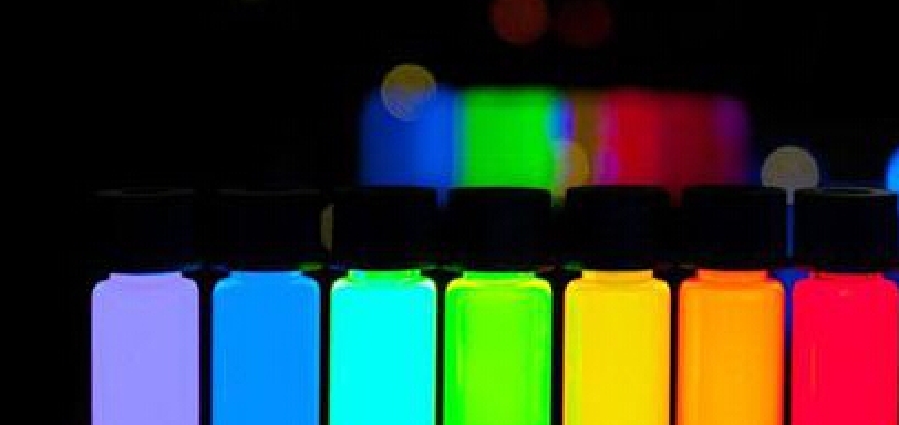
Driven by the demand for wide color gamut, high brightness and low power consumption in high-end display devices, quantum dot display materials have become a core solution to break through the performance bottlenecks of traditional fluorescent materials relying on the size-tunable quantum confinement effect. Different from traditional phosphors using rare earth elements, quantum dots are nanocrystals (2–10 nm in diameter) composed of II‑VI or III‑V group elements. Their emission wavelength can be precisely controlled by particle size (1–10 nm corresponds to 400–700 nm spectrum), achieving 100% Rec.2020 color gamut coverage and near‑unity quantum efficiency, providing ultimate color experience for TVs, monitors, AR/VR devices. Based on industrial measurement data and technological breakthroughs, this article analyzes the core advantages, application value and existing challenges of quantum dot display materials.
Core Technical Advantages: Redefining Display Color Standards
1. Ultra‑Wide Color Gamut and Precise Color Control
Color gamut coverage:
Cadmium‑based quantum dots (CdSe/ZnS) achieve 110% NTSC gamut coverage, 37.5% higher than traditional LCD’s 80%. The Samsung QN90C QD TV achieves 95% Rec.2020 gamut, closer to cinema‑grade color standards than OLED TVs (85%), with a peak red wavelength error < 2 nm.
Color purity and stability:
The full width at half maximum (FWHM) of quantum dots can be as narrow as 20–30 nm, only one‑third that of traditional phosphors (50–80 nm). The blue quantum dots in TCL C12 QD Mini LED TV have a FWHM of 22 nm, resulting in skin tone reproduction error ΔE<1, reaching professional monitor‑level accuracy.
2. High Luminous Efficiency and Energy Efficiency Ratio
Photoluminescence quantum yield:
Core‑shell structured quantum dots (such as InP/ZnS) can achieve a quantum yield above 95%, 35% higher than organic fluorescent materials (60–70%). LG Display’s quantum dot backlight module reduces power consumption by 25% at the same brightness, bringing standby power of 55‑inch TVs below < 0.5 W.
Thermal and optical stability:
Accelerated aging tests show that after 1000 hours at 85℃/85% RH, quantum dots maintain **>90%** luminous intensity, while traditional organic fluorescent materials degrade by more than 40%, ensuring color consistency over 50,000 hours of display life.
Key Technological Breakthroughs: Innovative Upgrades from Materials to Processes
1. Cadmium‑Free and Eco‑Friendly Material Development
Indium‑based quantum dot alternatives:
InP/ZnSe/ZnS quantum dots developed by Samsung SDI, using gradient alloy shell design, increase quantum yield from 70% to 92%, with cadmium content < 1 ppm (far below EU RoHS limit of 100 ppm). Applied in Xiaomi Master Series 82‑inch TV, they achieve 98% DCI‑P3 gamut and pass global environmental certifications.
Carbon quantum dot breakthrough:
Nitrogen‑doped carbon quantum dots developed by the Institute of Chemistry, CAS, achieve 88% aqueous‑phase quantum yield at only 1/5 the cost of InP quantum dots. They realize 5000 cd/m² brightness in flexible display backlights and meet e‑waste degradability requirements.
2. Device Structure and Packaging Technology
Quantum dot enhancement film (QDEF) optimization:
3M’s multi‑layer composite QDEF improves light extraction efficiency by 30% via microstructured scattering layers, raising LCD panel brightness from 500 cd/m² to 650 cd/m² while suppressing blue light leakage (450 nm band intensity reduced by 20%).
Inkjet printing and photolithography:
BOE’s quantum dot inkjet printing technology controls pixel pitch at 5 μm, realizing 600 PPI QD arrays on 8K panels. Material utilization increases from 30% to 90% compared with evaporation, reducing mass production cost by 40%.
Diversified Application Scenarios: From Consumer Electronics to Professional Displays
1. Consumer Display Devices
QD TVs and monitors:
Sony XR‑75X95EK QD TV uses XR Cognitive Processor to drive QD backlight, achieving dynamic contrast ratio of 1,000,000:1. In HDR movie playback, dark detail retention increases by 40%, and halo effect is reduced by 80% compared with traditional LCD.
Mobile device displays:
The AMOLED screen of Samsung Galaxy S24 Ultra integrates a QD enhancement film, reaching 2600 nits peak brightness in sunlight, 62.5% higher than the previous generation, while blue light radiation is reduced by 15% and passes SGS eye‑care certification.
2. Professional and Emerging Display Fields
Medical imaging displays:
Barco’s radiology displays adopt quantum dot calibration technology, with DICOM gray‑scale display error < 2%, clearly distinguishing 0.5 mm pulmonary nodules in CT images, improving diagnostic accuracy by 12%.
AR/VR near‑eye displays:
The waveguide display system of Microsoft HoloLens 2 integrates a QD emission layer, increasing monochromatic purity to 99.5%, virtual object edge sharpness by 30%, and field of view to 52°, enhancing mixed reality immersion.
3. Lighting and Optoelectronic Fields
Plant growth lighting:
Philips GreenPower QD growth lamps, using precisely matched 660 nm (red) and 450 nm (blue) quantum dots, improve photosynthetic efficiency by 20% over traditional LEDs, shorten lettuce growth cycle by 15%, and reduce energy consumption by 25%.
Bio‑fluorescent labeling:
Thermo Fisher’s QD labeling kits maintain luminescence stability for 24 hours (vs. 2 hours for traditional fluorescent dyes). In flow cytometry, single‑particle recognition accuracy reaches 99.8%, supporting early cancer diagnosis.
Existing Challenges and Solutions
1. Balancing Performance and Cost of Cadmium‑Free Quantum Dots
Challenge: The mass production cost of InP‑based QDs is three times that of Cd‑based ones, and quantum yield in the blue band (<450 nm) remains below 80%, limiting full‑spectrum applications.
Solutions:
Adopt ZnSe core‑shell structure instead of InP, raising blue quantum yield to 85% and cutting cost by 50% (e.g., TCL QLED 85X11D TV);
Optimize large‑scale liquid‑phase synthesis. BOE increased QD mass production yield from 60% to 88% using continuous‑flow reactors.
2. Moisture/Oxygen Stability and Lifetime Issues
Challenge: QDs easily oxidize in moisture and oxygen, causing 5–10% monthly luminescence decay, harming long‑term reliability.
Solutions:
Atomic layer deposition (ALD) packaging forms a 5 nm Al₂O₃ protection layer, reducing water‑oxygen permeability to 10⁻⁶ g/m²/day and extending lifetime to 100,000 hours;
Polymer microcapsule encapsulation. 3M’s QDEF uses dual barrier layers, keeping QD decay < 5% after 1000 hours at 85℃/85% RH.
3. Mass Production Process and Equipment Limitations
Challenge: Pixel uniformity error of QD inkjet printing reaches ±5%, and high‑precision coating equipment relies on imports with domestic penetration below 30%.
Solutions:
Develop AI visual calibration systems, controlling printing uniformity error within ±1.5% (e.g., Konka Micro QLED line);
CETC 45th Institute’s QD coater reaches 30 m/min at ±2 μm precision, replacing imported equipment and reducing cost by 40%.
With outstanding color performance and energy efficiency, quantum dot display materials are rapidly expanding from high‑end TVs to AR/VR, medical displays and other fields. With cadmium‑free breakthroughs, packaging upgrades and cost reduction, quantum dots are expected to become the next‑generation mainstream display technology after OLED, driving displays toward higher realism, energy saving and environmental protection, and redefining human visual interaction with the digital world.


