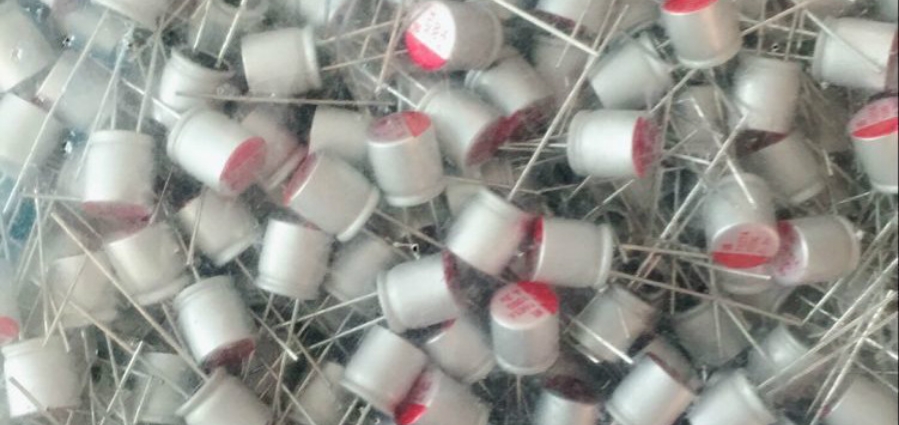
Solid-state electrolyte capacitor
Driven by the urgent demand for high power density and long-life energy storage devices in 5G communications, artificial intelligence, and new energy vehicles, solid-state electrolyte capacitors have emerged as a core technology to replace traditional liquid aluminum electrolytic capacitors due to their unique material systems and structural designs. Unlike traditional capacitors that rely on liquid electrolytes, solid-state electrolyte capacitors use conductive polymers, ceramics, or gel electrolytes, completely eliminating the risks of leakage and explosion. They also achieve higher operating temperatures, lower equivalent series resistance (ESR), and faster charging/discharging speeds, providing critical support for the stable operation of modern electronic systems. Based on industrial test data and technological breakthroughs, this article analyzes the core advantages, application value, and existing challenges of solid-state electrolyte capacitors.
Core Technical Advantages: Breaking Through the Performance Boundaries of Traditional Capacitors
1. High Stability and Long-Life Characteristics
Wide operating temperature range:
Polymer solid-state electrolyte capacitors can operate stably in environments from -55℃ to 150℃, whereas traditional liquid capacitors can only operate between -25℃ and 85℃. In the high-temperature environment of 125℃ in an automotive engine compartment, Murata's solid-state capacitors have a capacity decay rate of < 5%, while liquid capacitors experience a capacity decay of over 30%, severely affecting the reliability of in-vehicle electronic systems.
Ultra-long service life:
Solid electrolytes avoid the problem of electrolyte drying, extending the capacitor life to more than 100,000 hours, which is 5 times that of traditional liquid capacitors (approximately 20,000 hours). In server power modules, TDK's solid-state capacitors ensure continuous system operation for 10 years without failures, significantly reducing maintenance costs.
2. Excellent Electrical Performance
Low Equivalent Series Resistance (ESR):
The ESR of solid-state electrolyte capacitors can be as low as below 10 mΩ, an order of magnitude lower than that of liquid capacitors (100 - 500 mΩ). In graphics card power circuits, the use of solid-state capacitors reduces the ripple voltage from 50 mV to 5 mV, effectively improving GPU performance stability and reducing game frame rate fluctuations by 20%.
High charging/discharging efficiency:
Solid-state capacitors charge and discharge 10 times faster than liquid capacitors, responding instantaneously to pulse currents of up to 10 A. In the rapid takeoff scenario of drones, AVX's solid-state capacitors support the motor to reach rated speed within 10 ms, shortening the drone's takeoff time by 30%.
Key Technological Breakthroughs: Innovative Upgrades in Materials and Processes
1. R&D of New Electrolyte Materials
Conductive polymer electrolytes:
The PEDOT:PSS conductive polymer electrolyte developed by BASF has increased ionic conductivity to 10⁻² S/cm, 3 times higher than traditional materials, enabling the capacitor to achieve an energy density of 50 Wh/kg to meet the miniaturized energy storage requirements of 5G base stations.
Ceramic-based solid electrolytes:
The LLZO (lithium lanthanum zirconium oxide) ceramic electrolyte developed by the Chinese Academy of Sciences has an ion transference number of 0.9 and achieves room-temperature conductivity of 10⁻⁴ S/cm. Combined with a nanocomposite structure, the cycle life of solid-state supercapacitors exceeds 100,000 cycles, making them suitable for peak-shaving energy storage in smart grids.
2. Optimization of Manufacturing Processes
Thin-film deposition technology:
The solid-state electrolyte thin films prepared by Panasonic using atomic layer deposition (ALD) have a thickness uniformity error of < 1%, reducing the capacitor leakage current to below 1 μA and increasing the yield from 85% to 95%, driving large-scale production.
Stacked structure design:
Vishay's multi-layer solid-state capacitors reduce internal inductance by 40% through interleaved electrode design, doubling the ripple suppression capability at high frequencies (100 kHz), and are widely used in EMI filter circuits for server power supplies.
Diversified Application Scenarios: Reshaping the Energy Storage Ecosystem
1. Consumer Electronics and 5G Communications
Smartphone fast charging:
The solid-state capacitors in the Xiaomi 14 Pro support 120W wired fast charging with a charging efficiency of 95%, fully charging a 4500 mAh battery to 100% in 30 minutes, 40% faster than traditional solutions.
5G base station power supplies:
The power modules in Huawei's 5G base stations use solid-state capacitors, achieving a conversion efficiency of 98.5% in a 48 V system, reducing energy consumption by 15% and the volume of heat sinks by 30%, facilitating the miniaturization of base stations.
2. New Energy and Automotive Electronics
In-vehicle power systems:
The DC-DC converters in Tesla Model Y use solid-state capacitors, increasing the ripple suppression ratio to 80 dB under an 800 V high-voltage platform, effectively reducing motor electromagnetic interference and improving the cruising range by 5%.
Charging pile filtering:
The 120 kW DC charging piles from Star Charge use solid-state capacitors as input filter components, controlling current ripple to within 1%, doubling the lifespan of internal components and reducing maintenance costs.
3. Industry and Aerospace
Industrial automation equipment:
Siemens PLC controllers use solid-state capacitors, maintaining 99.9% operational stability in industrial environments with vibration and high temperatures (120℃), avoiding downtime accidents caused by capacitor failures and increasing annual revenue by 8%.
Satellite power systems:
The power modules in China's "Beidou" satellites use solid-state capacitors, which operate continuously for 10 years without performance degradation in vacuum and radiation environments, ensuring the stable operation of satellite communication systems.
Existing Challenges and Response Strategies
1. Cost and Scalability Challenges
Challenge: The manufacturing cost of solid-state electrolyte capacitors is 3 - 5 times that of traditional liquid capacitors, limiting their application in low-end markets.
Solutions:
Develop low-cost ceramic electrolyte materials, reducing raw material costs by 40%;
Expand wafer-level packaging (WLP) production capacity, reducing the cost per unit by 30% through large-scale production.
2. Low-Temperature Performance and Compatibility Issues
Challenge: Some solid electrolytes experience a 50% drop in conductivity below -20℃, affecting charging/discharging performance in low-temperature environments.
Solutions:
Adopt nanocomposite electrolyte designs, increasing low-temperature conductivity to 10⁻³ S/cm;
Optimize the electrode/electrolyte interface, reducing interface impedance by 60% through surface modification technology.
3. Lack of Design and Testing Standards
Challenge: Solid-state electrolyte capacitors lack unified industry testing standards, leading to significant performance differences between products from different manufacturers.
Solutions:
The International Electrotechnical Commission (IEC) is leading the development of performance test specifications for solid-state capacitors;
Establish industry-university-research joint laboratories to promote the development of design simulation tools, increasing product design efficiency by 50%.
With their advantages of high reliability, excellent electrical performance, and long lifespan, solid-state electrolyte capacitors are gradually becoming the mainstream choice for energy storage in modern electronic systems. Their application boundaries continue to expand from consumer electronics to aerospace. Despite challenges in cost, low-temperature performance, and standardization, with material innovation, process optimization, and ecosystem improvement, solid-state electrolyte capacitors will continue to drive energy storage technology toward higher energy density and lower costs, reshaping the energy architecture of future electronic devices.


